
Using Claude in AppSec: What to Automate and What to Govern
Five practical lessons from Perry Menezes at apisec|con 2026 on using Claude in application security, with exercises you can try on your own systems.


Here's what you'll learn: why most application vulnerabilities are logic flaws scanners miss, why your API inventory is probably wrong, where AI helps in application security (AppSec) and where it can mislead you, what to do when your tools disagree, and why an AI agent needs the same controls as any privileged account.
The lessons come from Perry Menezes, Cyber & AI Tech Risk and Advisory Exec, who spoke at apisec|con 2026. Perry started as a Unix and systems programmer, then spent 15 years on the risk and oversight side of financial services. His session, How To Build an Appsec Program with Claude, uses Anthropic's Claude as the example, but the lessons apply to any AI model you bring into security work.
Lesson 1: Most API flaws are logic flaws
The OWASP API Top 10 is the industry's list of the most common API security risks. Perry's point is that most of them are about logic, not syntax. Take Broken Object Level Authorization (BOLA): the endpoint checks that you are logged in, but never checks that the record you asked for belongs to you. The code looks fine. Change an ID in the request and you get someone else's data.
Excessive data exposure works the same way. The response is perfectly formed, but it hands back fields nobody should see.
"It's a reasoning problem, and that's exactly where we find that the scanners and some of the tools are at their weakest." [12:46]
The takeaway for testers: to find these flaws, you have to understand what each endpoint is supposed to do, then check what it actually does.
Lesson 2: Your inventory is probably wrong
In the example Perry shared, an API inventory listed 340 services. Checked against what was actually running, there were 412. One was a version one mobile banking API "that should have been retired two years ago but was still running account details." [24:04] Nobody owned it, and nobody had tested it in years.
Perry's rule is that every API needs three things: a named owner, a data classification (what kind of data it handles) and a known exposure (whether it can be reached from the internet). "You can't prioritize by exploitability if you don't even know exposure." [24:43]
Lesson 3: AI adds capacity, but it can be confidently wrong
Perry describes AI as capacity, not another scanner: something like an analyst that reads code, specs and tickets and reasons across them. His example prompt gives Claude an OpenAPI spec (a machine-readable description of an API) and asks for every endpoint that returns customer data, where authorization is enforced, and to say so when it can't find it. A person might need days. The model needs minutes.
Then comes the caveat:
"Claude can be confidently wrong. It's not deterministic." [15:01]
Not deterministic means the same question can get a different answer on the next run. So a person always checks the result, and you never treat one AI run as proof.
Lesson 4: When tools disagree, write it down
Perry's advice for teams that already run scanners is "blend it, don't replace it." [18:43] Keep tools such as static analysis (SAST) for the rule-based work, and use AI as a reasoning layer on top. Sooner or later they disagree: the scanner says critical, the AI says the vulnerable code can't be reached.
"Your scanner says critical, but Claude says, "I'm not reachable." What do you do then, right? Write it down." [21:53]
Decide in advance whose severity wins, and record each decision. That record is called a risk acceptance: a documented decision to accept a risk, with the reason. It's the evidence auditors ask for.
Lesson 5: An AI agent is a privileged identity
When an AI tool can read your code, open pull requests, run commands and connect to other systems through MCP (the Model Context Protocol, a standard way for AI agents to call tools), it has real access. Perry calls it a privileged identity: an account with powerful permissions that needs controls.
"Now it's actually Claude as a privileged identity, right? This is where most AI talks skip." [31:47]
His example of the risk is a code comment written to trick the AI reviewer into approving a file. That's prompt injection: instructions hidden in data the AI reads. The defenses are familiar: a human approves every change, patches are never applied automatically, only approved MCP servers are allowed, and each agent gets only the tools it needs.
Try it yourself
Run these only on systems you own or on intentionally vulnerable practice apps such as OWASP crAPI. Never test an application you don't have permission to test.
- Build your own inventory. Run the free, open-source apisec Surface tools on a codebase you own and list every route they find. Compare the list with your API documentation. Anything in the code but not in the docs is a gap.
- Test for BOLA with two accounts. In a practice app, create two users. Log in as user A, request one of user B's records by changing the ID in the request, and see whether the API returns it. Try every verb, not just GET.
- Ask an AI, then check its work. Give a model the OpenAPI spec for an API you own and ask Perry's question: which endpoints return customer data, and where is authorization enforced? Verify each answer by hand, and run the same prompt twice to see whether the answers change.
- Write a one-page agent risk register. Pick an AI tool you use for coding. Write down what it can access, how much it can do without a human, what could go wrong, which controls limit it, and who owns it.
Keep learning
Perry teaches these ideas in depth in his apisec University course, Foundations of AI-based Application Exploitability. Watch the full session above, then start the course to learn how to tell which issues an attacker can actually use.
Latest Articles
AI Agents Are Running the API Security Syllabus. Here's What to Study.
The FBI published what AI attack agents exploit. Every weakness on the list is one you can learn to find and fix. Here's where to start.
What Happens When You Report a Cyber Incident to the FBI
When should you report a cyber incident, and what happens next? Six practical lessons from FBI Special Agent David Dahle at apisec|con 2026.
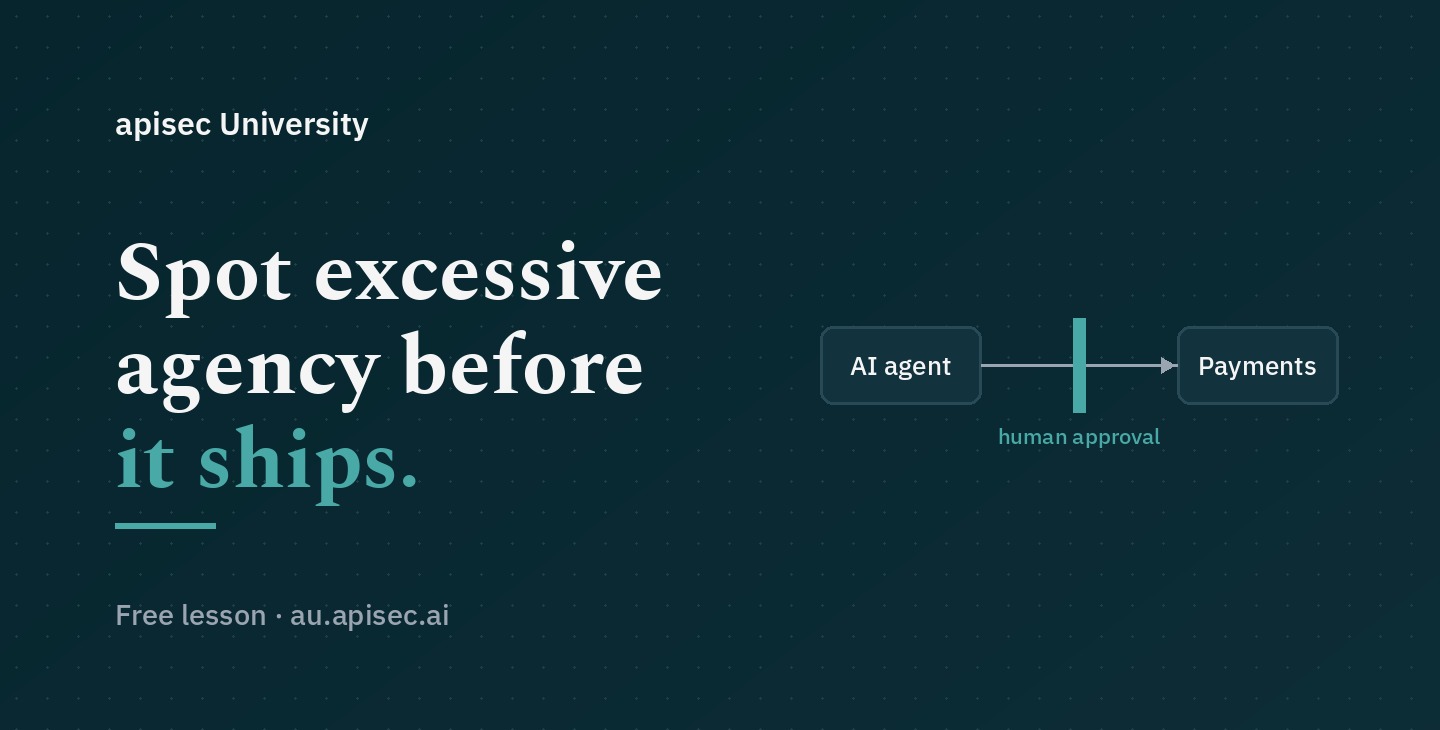
How to Spot Excessive Agency in an AI Agent Before It Ships
Learn to spot excessive agency in an AI agent, fix it with a human approval gate, and see why a fix in code still needs runtime testing.
AI Agents Are Running the API Security Syllabus. Here's What to Study.
The FBI published what AI attack agents exploit. Every weakness on the list is one you can learn to find and fix. Here's where to start.
What Happens When You Report a Cyber Incident to the FBI
When should you report a cyber incident, and what happens next? Six practical lessons from FBI Special Agent David Dahle at apisec|con 2026.
Earn your APIsec University Certificate
Earn an APIsec University certificate and badge for completing any of our courses.
Post your badge on LinkedIn and share your accomplishments. You can even receive CPE credits for taking these courses.


